Jailbreak.
The truth refuses to be extinguished.

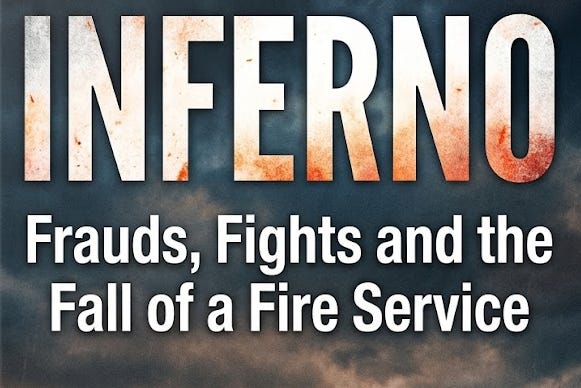
I have been informed “off record, without prejudice” that the Best Value Inspection commissioned by the Government which crossed two administrations either side of a General Election is to be binned. The Minister retains discretion to publish an abridged or heavily redacted version. But, I am informed that there is fear of a total loss of public confidence in both the wider Fire and Rescue Service and the controlling Labour-led Fire Authority in the West Midlands.
There is also the potential for criminal proceedings to arise against specific individuals, should a thorough report be published. Lets take a look, even though it is old ground to cover Wayne again, but necessary to see what could arise as a result.
The information in this article below is one of the primary reasons why the Minister may want to squash the BVI report. A public organisation with a budget of over £100M and it’s officers and senior employees culpable in several layers of criminality. We haven’t touched the RASSO allegations that have been made against Brown by female staff, nor have we touched the involvement of West Midlands Police and the Crown Prosecution Service. You can read more about that as there may be a book coming out. Have I mentioned that?
Jailbreak.
An independent investigation by external auditors Grant Thornton confirmed that former Chief Fire Officer Wayne Brown did incorrectly claim to hold a Master of Business Administration (MBA) degree on his CV.
Wayne Brown had a strong prospect of conviction for Section 2 fraud and misconduct in public office, while a conviction for perverting the course of justice would heavily depend on proving he intentionally fabricated evidence to frame myself to conceal his own wrongdoing. Because Brown took his own life in January 2024 before formal criminal charges could be brought or tried, no definitive verdict exists.
If an individual were hypothetically convicted of all three offences in an English court, the total sentence would realistically range from a minimum of 2 to 3 years in prison up to a maximum of a life sentence (though a realistic maximum under standard sentencing guidelines would be 7 to 10 years).
A breakdown of Brown’s legal likelihood of conviction and the corresponding sentencing guidelines
Wayne Brown (Former CFO)
Likelihood of Conviction
1. Fraud by False Representation (Section 2, Fraud Act 2006)
Likelihood: Extremely High
The Evidence: An internal West Midlands Fire Service (WMFS) probe and an subsequent inquest confirmed that Brown did not possess the Master in Business Administration (MBA) degree required for his Chief Fire Officer role. He admitted to colleagues that he had not finished the degree and apologised. Fabricating a qualification to gain a high-salaried public position constitutes clear fraud by false representation for financial gain.
2. Misconduct in Public Office (Common Law)
Likelihood: Extremely High
The Evidence: Misconduct in public office requires a public officer to wilfully neglect their duty or misconduct themselves to such a degree that it amounts to an abuse of the public’s trust. Securing the top office of a major emergency service using a fabricated identity/qualification, combined with allegations of using police powers as a proxy to silence a whistleblower, meets the high threshold of “culpability” required for this common law offence.
3. Perverting the Course of Justice (Common Law)
Likelihood: Moderate to High (Evidentiary Dependent)
The Evidence: This charge relies on the dynamic between Brown and whistleblower Ben Walker. Brown had accused Walker of harassment, resulting in Walker’s arrest. However, police forensics later proved Walker was not behind the anonymous email accounts used to substantiate the harassment claim, leading a judge to later call the case a “malicious prosecution“. To convict Brown, the Crown would have had to prove he knowingly fabricated the link or actively misled the police to falsely orchestrate Walker’s arrest.
Likely Sentencing Ranges (If Convicted)
In English law, when a defendant is sentenced for multiple offences arising out of a connected course of conduct, judges apply the principle of totality. Sentences are usually served concurrently (at the same time) rather than consecutively (added together), unless the offences are entirely distinct.
The individual maximum penalties and realistic sentencing ranges dictate the following outcomes:
Section 2 Fraud
Maximum: 10 years imprisonment
Likely: 2 to 5 years (High value, high breach of trust)
Misconduct in Public Office
Maximum of Life imprisonment
Likely: 3 to 7 years (Given the senior executive level)
Perverting the Course of Justice
Maximum of Life imprisonment
Likely: 4 to 9 years (As it involves manipulating the police/courts)
The Absolute Minimum Sentence
Estimated: 2 to 3 years imprisonment
Context: Even with strong mitigation (e.g., previous unblemished public service, positive character references, and mental health struggles), a custodial sentence would be unavoidable for Brown. The severe breach of public trust means the court would not have considered a suspended sentence.
The Absolute Maximum Sentence
Statutory Maximum: Life Imprisonment (via Misconduct in Public Office and Perverting the Course of Justice).
Realistic Judicial Maximum: 7 to 10 years imprisonment
Context: While life imprisonment is technically available on paper for common law offences, it is reserved for the most extreme cases (such as a police officer helping a murderer escape).
In a scenario involving CV fraud and orchestrating a malicious prosecution against a whistleblower, a judge applying the sentencing guidelines would likely impose a single headline sentence of around 7 to 10 years, reflecting the serious abuse of emergency service power.
Greg Brackenridge (Former Chair of the Fire Authority)
Potential Offences & Criminal Liability
Misconduct in Public Office (MIPO): This common-law offence requires a public officer to willfully neglect their duty or misconduct themselves to such a degree that it amounts to an abuse of the public’s trust, without reasonable excuse.
Application: Personally appointing Wayne Brown twice without validating essential minimum qualifications (e.g., an MBA postgraduate degree mandatory for Chief Fire Officers), combined with actively ignoring formal whistleblowing channels used by Walker, satisfies the threshold for willful neglect of a statutory duty.
Fraud by False Representation (Section 2, Fraud Act 2006): Brackenridge publicly embellished his military career, claiming to have “served as a Royal Marine” when he was only briefly a recruit.
Application: If this false representation was utilised to secure his public role, political advancements, or financial allowances (pecuniary gain), it constitutes statutory fraud.
Accessorial Liability (Perverting the Course of Justice): If Brackenridge approved or knew of a targeted media operation via DRD Partnership to smear Walker as a “far-right extremist” to influence a live police/CPS process or silence a statutory whistleblower, he could be prosecuted as a principal or accessory to perverting the course of justice.
Prosecution Likelihood & Sentencing
Likelihood of Prosecution: Medium to High. Public standards investigations have already confirmed severe code of conduct breaches regarding his fabricated military record. The systemic failure to investigate a critical qualification fraud within an emergency service elevates this to a matter of acute public interest.
Likely Sentence Upon Conviction:
MIPO: 3 to 7 years imprisonment (maximum penalty is life).
Fraud Act 2006: 18 months to 4 years imprisonment (maximum penalty is 10 years).
Satinder Sahota (Former Monitoring Officer)
Potential Offences & Criminal Liability
Misconduct in Public Office (MIPO): As the designated Monitoring Officer under Section 5 of the Local Government and Housing Act 1989, Sahota had a strict statutory duty to report any illegality or formal governance breaches within the authority.
Application: Failing to perform robust background checks on executive qualifications, failing to record official notes, ignoring formal complaints, and drawing a strict Prevention of Future Deaths report from a Coroner for procedural failures during an inquest collectively represent gross, systemic neglect of duty.
Conspiracy to Pervert the Course of Justice / Malicious Prosecution: Supporting a criminal prosecution against Walker for harassment, which the CPS ultimately dropped due to having “no realistic prospect of conviction”, while actively withholding exculpatory evidence or covering up qualification fraud crosses into systemic corruption.
Application: Directing public funds to a PR firm (DRD Partnership) to intentionally orchestrate a false “far-right/crank” narrative to discredit a witness in criminal proceedings constitutes a coordinated effort to subvert justice.
Prosecution Likelihood & Sentencing
Likelihood of Prosecution: Medium. While courts grant wide discretion to corporate decisions, a Monitoring Officer is a lawyer bound by strict regulatory and statutory duties. If evidence demonstrates he intentionally suppressed qualification anomalies to protect the authority’s reputation while enabling a flawed prosecution, criminal charges are viable.
Likely Sentence Upon Conviction:
Conspiracy to Pervert the Course of Justice: 4 to 9 years imprisonment (highly aggravated due to his status as a senior legal officer of the court).
MIPO: 2 to 5 years imprisonment.
Simon Barry (Former Deputy Chief Fire Officer)
Potential Offences & Criminal Liability
Unauthorised Surveillance under RIPA 2000: Conducting directed surveillance on an individual without formal authorisation under the Regulation of Investigatory Powers Act 2000 (RIPA) is a severe violation of statutory powers.
Application: Public bodies are strictly barred from deploying surveillance outside RIPA frameworks. Barry bypasses civil liability and enters criminal territory under the Data Protection Act 2018 (Section 170: Unlawful obtaining of personal data) and potentially the Computer Misuse Act 1990 if digital snooping was involved.
Misconduct in Public Office (MIPO): Utilising operational fire service counter-intelligence resources to conduct rogue surveillance on a civil whistleblower constitutes a severe, bad-faith abuse of public office.
Stalking / Harassment: If the surveillance bypassed legislative frameworks to intimidate Walker, Barry could be indicted under the Protection from Harassment Act 1997.
Prosecution Likelihood & Sentencing
Likelihood of Prosecution: High (specifically regarding data and surveillance offences). Rogue surveillance by public officials lacking a signed statutory warrant offers clear, objective digital and physical evidence trails that are straightforward to prosecute.
Likely Sentence Upon Conviction:
MIPO (Rogue Surveillance context): 18 months to 3 years imprisonment.
Data Protection Act 2018 (Section 170): Generally a heavy criminal fine, but paired with MIPO, it acts as a significant aggravating factor driving a custodial sentence.
Corporate Liability: DRD Partnership and Binary Narrative.
Engaging a private communications firm using public taxpayer funds to construct a demonstrably false narrative to frame a whistleblower as a “racially motivated activist” constitutes an overt act of conspiracy to pervert the course of justice.
Under English law, if two or more public officials agree to use deceptive campaigns to influence a police investigation or contaminate the public domain against a defendant/witness, the offence is complete upon agreement.
This elevatse the sentences for all three individuals to the higher bands of custodial guidelines, reflecting a calculated, weaponised abuse of state power.
Joanne Bowcock (former temporary, seconded, Deputy CFO)
Making a False MG11 Statement & Inculcating Mitchell Bowcock
The Offence: Perverting the Course of Justice (Common Law).
Culpability: High. Fabricating or coordinating a false Section 9 (MG11) witness statement to initiate or support a malicious prosecution against Walker is a clear act intended to distort the path of justice. Fabricating evidence or pressuring/inculcating a relative (Mitchell Bowcock) to submit a conflicting, manufactured statement constitutes an aggravating feature. Under the Criminal Justice Act 1967, signing a Section 9 statement knowing it contains material falsehoods is also a standalone offence.
2. Provably False Written Statement to the Coroner
The Offence: Perjury (Perjury Act 1911) or Perverting the Course of Justice.
Culpability: High. Bowcock’s written statement read at HM Coroner’s Court contained several falsehoods and inconsistencies, which were subsequently challenged in public records and by Walker’s legal team as posthumous fabrication. Providing knowingly false written evidence to a Coroner’s Court, which operates as a court of record, satisfies the statutory definitions of perjury and perverting the course of justice.
3. CV and Qualification Fraud
The Offence: Fraud by False Representation (Section 2, Fraud Act 2006).
Culpability: High. Investigative reports and external audits by the West Midlands Fire Service confirmed Bowcock falsely claimed to hold a three-year law degree from the University of Liverpool. Using a fake qualification to secure high-ranking, lucrative public office roles (such as Assistant and Deputy Chief Fire Officer) satisfies the threshold of making a dishonest representation with the intent to make a gain or cause a loss.
4. Delay in Reporting Wayne Brown’s Body
The Offence: Misconduct in Public Office (Common Law) or Perverting the Course of Justice.
Culpability: Dependent on Evidentiary Proof. If it is proven that Bowcock discovered Wayne Brown’s body at Wake Green Road but deliberately withheld the information, instead sending subordinates (Marc Hudson and Kris Darnley) to “discover” him to distance herself from a tabloid scandal, her actions would constitute a gross breach of public trust. Intentionally manipulating a sudden death scene or delaying emergency services to protect personal reputation easily amounts to Misconduct in Public Office.
Likelihood of Prosecution & Sentencing Expectations
Likelihood of Prosecution: Very High
The public collapse of the prosecution against Walker, coupled with damning external audit findings regarding “faked qualifications” within the fire service, places immense pressure on West Midlands Police and the CPS to act. Because Walker secured Interested Party status at the inquest and is pursuing civil remedies, a formal police file regarding Bowcock’s statements is highly likely to be actioned.
Likely Sentence Upon Conviction
Perverting the Course of Justice
Likely: 4 to 6 years (Conspiracy, fabrication of statements, and institutional manipulation place this in Category A/B high culpability).
Perjury (Coroner’s Court)
Likely: 2 years (Consecutive or concurrent depending on judicial discretion).
Fraud by False Representation
Likely: 18 months (Based on the high financial gain of a DCFO salary over multiple years).
Note: Perverting the course of justice almost explicitly carries a mandatory immediate custodial sentence in English courts, meaning a non-custodial or suspended sentence is highly improbable.
Impact of Emigration to Canada: Extradition & Civil Proceedings
If Bowcock attempts to evade these legal issues by relocating to Canada, multiple international legal frameworks will immediately be triggered.
1. Extradition Process
The Treaty: Extradition between the UK and Canada is governed by the UK-Canada Extradition Treaty and Canada’s Extradition Act.
Dual Criminality: For extradition to succeed, the crimes must be offences in both nations. Perverting the course of justice, perjury, and high-value fraud perfectly mirror Canadian Criminal Code offences (such as Obstructing Justice under Section 139 and Perjury under Section 131).
The Mechanism: Once West Midlands Police issue an arrest warrant and the CPS secures a charge, the UK Home Office will transmit a formal extradition request to Canada’s Department of Justice. Canadian authorities will, in that case, arrest Bowcock on an international warrant, holding her in custody or under strict bail terms pending an extradition hearing.
2. Summons to Appear
If charges are filed before she leaves, or while she is abroad, a formal international summons can be served via Global Affairs Canada. Ignoring a criminal summons will trigger an immediate Warrant for Arrest First Instance, effectively making her an international fugitive and forcing an Interpol Red Notice.
3. Tandem Civil Proceedings
Emigration will not shield her assets or prevent civil litigation:
Malicious Prosecution Claim: Walker can initiate a civil suit for malicious prosecution and misfeasance in public office against Bowcock individually, alongside the institutional defendants.
International Service: Under UK Civil Procedure Rules (CPR Part 6), Walker’s legal team can easily obtain court permission to serve civil claims on her outside the jurisdiction in Canada.
Enforcement of Assets: Should Walker win a substantial damages award against an individual, the UK judgment can be registered and enforced against her Canadian bank accounts, property, or wages via reciprocal enforcement acts active in all Canadian provinces.
Westminster worried?
I believe in transparency and that in the words attributed to Cromwell, that the report should be released in it’s unredacted form, “…warts and all.” I can though understand why all of the above has caused serious concerns. The situation that arose was surreal and is barely believable, but until it is resolved with finality, the Sword of Damocles hangs by a single horsehair above those mentioned and some not. And…if I know the Fire Service, and I do, nobody at that level is going to fall on their own sword and others shall be taken down. Many may be circling the drain and don’t even realise.
A nice thick slice…
Of Thin Lizzy. Enjoy.